
EPC Delivery of a High‑Performance PV Plant in a Semi‑Arid Region
Location: Inner Mongolia Autonomous Region, China
Project type: Ground‑mounted solar photovoltaic power station
*Capacity: 100 MWp (DC) / 80 MWac (AC)*
Status: Commissioned August 2025
Project Overview
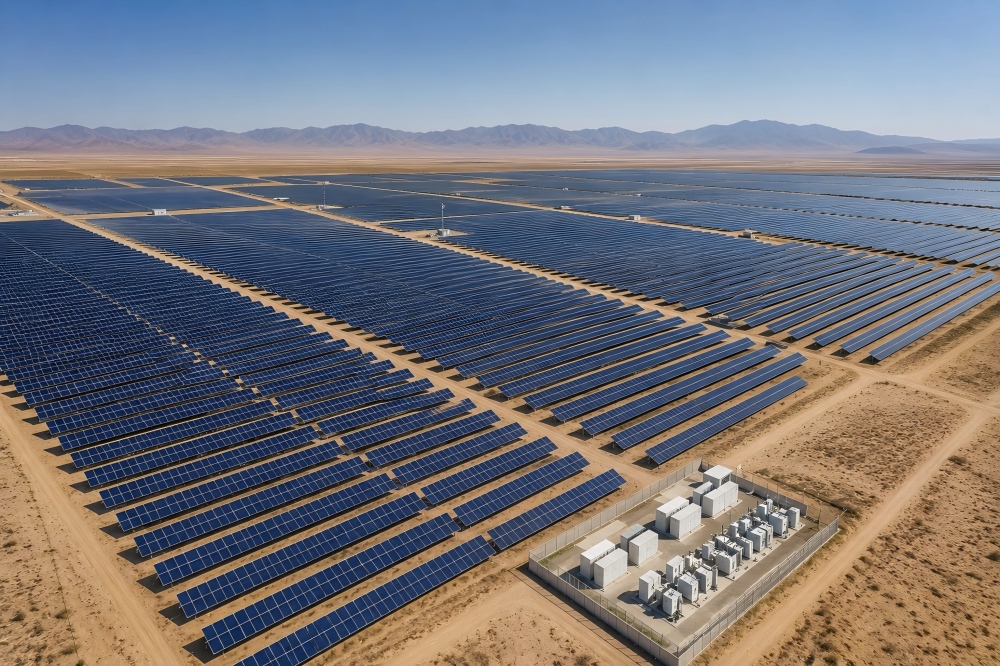
As part of China’s national renewable energy base construction plan, our company acted as the EPC contractor for a 100 MWp photovoltaic power station in a semi‑arid grassland area of Inner Mongolia. The client, a state‑owned power generation group, needed to meet its clean energy quota while demonstrating cost‑effective and rapid deployment.
We designed, procured, and constructed the plant on 220 hectares of gently sloping land. The installation uses monocrystalline bifacial modules mounted on fixed tilt structures, combined with string inverters and a central SCADA system. The plant now feeds clean electricity into the local grid, displacing approximately 130,000 tons of CO₂ annually.
Why This Location? Abundant Sunlight, Favorable Terrain
Inner Mongolia receives over 2,900 hours of sunlight per year, with annual irradiation exceeding 1,700 kWh/m². The site is flat, with no forest cover or agricultural use, minimising land‑use conflicts. The existing 110 kV transmission line runs 3 km from the site, reducing grid connection costs. Average temperatures range from -20°C in winter to 35°C in summer, with low humidity and occasional sandstorms in spring.
Technical Highlights
Bifacial Modules with High Albedo
We installed 185,000 monocrystalline bifacial modules, each rated at 540 Wp. The modules capture light from both front and back. The ground surface was prepared with a layer of light‑coloured crushed stone to increase albedo to 0.35, boosting rear‑side gain. Measured bifacial gain is 9.5% above the monofacial baseline.
Module efficiency at standard test conditions is 21.2%. The temperature coefficient is -0.35%/°C, which performs well in this climate (better than typical -0.4%/°C). We selected half‑cell technology to reduce resistive losses and improve performance under partial shading.
Fixed Tilt vs. Trackers: The Right Choice
We evaluated single‑axis trackers but found that the higher capital cost (approx. +25%) would not be justified given the site’s high direct normal irradiance and low labour costs for cleaning. Fixed tilt at 32° (optimised for annual yield) gave the lowest levelised cost of energy. The structure uses galvanised steel posts driven 2.2 metres into the ground to withstand local wind loads of 130 km/h.
String Inverters for Granular Monitoring
We chose 225 kW string inverters, each connected to 30‑35 module strings. Total of 356 inverters distributed across the site. Benefits over central inverters:
- No DC combiner boxes (reduces fire risk and voltage drop)
- Each string independently monitored
- If one inverter fails, only a small block (approx. 0.3 MW) is lost
- Faster replacement due to lighter weight
Each inverter has an IP66 enclosure, rated for -25°C to 60°C ambient. Built‑in surge protection and DC disconnects meet local grid code requirements.
Underground Cabling and Collector System
We installed 78 km of DC cabling (4 mm², copper) and 22 km of AC cabling (35 kV, aluminium). All cables are buried at 0.8 m depth to protect against temperature extremes and grazing animals. The collector system combines 10 feeder lines, each serving 10 MW of inverters, feeding into a newly built 110 kV/35 kV substation.
Remote Monitoring and Control
The SCADA system collects real‑time data from every inverter and weather sensor. Operators can view performance dashboards, receive alerts for underperforming strings, and remotely adjust inverter parameters. The system also includes a PV simulation module that compares actual output to modelled output based on irradiation and temperature, flagging any unexpected deviations.
Project Challenges and Our Solutions
Challenge 1: Short Construction Window
The construction season in Inner Mongolia is limited to April‑October due to winter freezing. To compress the 12‑month schedule into 9 months, we overlapped design, procurement, and civil works. Module orders went out before the layout was finalised – a calculated risk of mismatch. And we deployed two civil crews to work in parallel on different sections of the site.
Challenge 2: Spring Sandstorms
Sandstorms in March‑May reduce visibility and can damage modules. We scheduled module installation after the sandstorm season (starting June). For the few early modules that were temporarily placed, we covered them with protective fabric. The anti‑reflective coating on the modules has a hardness rating of 4H, resisting scratching. Post‑construction, we installed a mobile cleaning cart that blows compressed air across modules to remove dust without water.
Challenge 3: Remote Site Logistics
The nearest town is 60 km away, with limited accommodation. We set up a temporary construction camp with 200 beds, a canteen, and a first‑aid station. Weekly supply convoys brought modules, inverters, and steel structures from a regional distribution centre 400 km away. We maintained a buffer stock of 10% extra modules to cover breakage or defects.
Challenge 4: Grid Connection Approval
The grid operator required a detailed power quality study, including harmonic analysis and reactive power capability. We commissioned an independent consultant to model the plant’s impact. The study confirmed that the inverters’ reactive power control (0.95 leading to 0.95 lagging) meets grid code. Approval took four months – we started the process early, before finishing civil works, to avoid delaying commissioning.
Project Results After One Year of Operation
Data collected from September 2025 to August 2026.
| Metric | Result |
|---|---|
| Total electricity generated | 178,000 MWh |
| Performance ratio (PR) | 83.5% (guaranteed: 82.0%) |
| Availability | 99.3% |
| Module degradation (first year) | 0.7% (warranty allows 1%) |
| CO₂ emissions avoided | 130,000 tons |
| Local jobs created (peak construction) | 180 |
| Permanent O&M jobs | 6 |
| Levelised cost of energy (LCOE) | $0.028/kWh |
| Simple payback for client | 6.5 years |
The client sells power under a 20‑year PPA at a fixed tariff of $0.042/kWh, generating steady revenue. The plant achieved financial close with a debt‑to‑equity ratio of 70:30, supported by our performance guarantees.
Environmental and Social Benefits
- Carbon reduction: 130,000 tons CO₂ annually, equivalent to taking 28,000 cars off the road.
- Water conservation: PV generation consumes no water, saving approximately 1.2 million cubic metres per year compared to a coal plant of equivalent output.
- Land use: The site remains accessible for sheep grazing (a traditional local activity). Module cleaning uses compressed air, no water.
- Community engagement: We funded a 1 km gravel road connecting two villages to the county highway, and donated 50 streetlights powered by small PV kits to a nearby school.
What the Client Says
“This was our first large‑scale PV project, and the EPC team delivered beyond expectations. They managed the tight schedule without compromising quality. The plant consistently generates 4‑5% above the guaranteed output. We are now discussing a second 200 MW phase on adjacent land.”
— Project Manager, Inner Mongolia New Energy Investment Group
Why This Project Demonstrates Our EPC Strength
- Speed: 9 months from notice to proceed to commercial operation, despite a challenging climate.
- Quality: Performance ratio consistently above guarantee, availability above 99%.
- Local impact: Created 180 construction jobs, trained local O&M technicians, and invested in community infrastructure.
- Financial discipline: Came in 3% under budget, with no cost overruns or change orders.
Lessons for Future PV Construction Projects
1. Start grid studies early
Grid approval often takes longer than construction. Initiate the power quality study and permit applications as soon as the site is identified.
2. Plan for dust and sand
In semi‑arid regions, invest in anti‑soiling coatings and dry cleaning systems. Water is scarce and labour‑intensive wet cleaning is not sustainable.
3. Use string inverters for reliability
Central inverters create single points of failure. String inverters may cost slightly more upfront but reduce downtime and simplify maintenance.
4. Build a local supply chain
Establish relationships with regional distributors to shorten logistics. Buffer stock of key components (modules, inverters, cables) prevents delays.
5. Train local workers early
A trained local workforce reduces reliance on expatriate engineers. Start classroom training before site work begins, then supervised on‑the‑job training during installation.
Common Questions About Photovoltaic Power Station Construction
Q: How long does it take to build a 100 MW PV plant?
Our typical schedule is 9‑12 months from notice to proceed to commercial operation, depending on seasonality and grid connection complexity.
Q: What is the typical land requirement?
Approximately 2‑2.5 hectares per MW for fixed tilt systems, or 3‑3.5 hectares per MW for single‑axis trackers (due to spacing requirements).
Q: How do you handle snow or ice?
In regions with occasional snow, modules are tilted at >25°, so snow slides off naturally. We do not install heaters; the cost outweighs the energy gain in most cases.
Q: What is the module degradation rate?
Standard warranty is 1% in year one, then 0.4‑0.5% per year thereafter. Our chosen modules have recorded 0.7% first‑year degradation.
Q: Do you offer O&M services after construction?
Yes. We offer 5‑year or 10‑year O&M contracts including remote monitoring, scheduled cleaning, preventive maintenance, and warranty claims management.
Q: Can you build PV plants on uneven or hilly terrain?
Yes, but it increases structural costs and reduces row density. We always perform a detailed topographic survey and recommend appropriate foundation designs (driven piles, screw piles, or concrete footings).
Ready to Start Your Photovoltaic Power Station Construction?
Whether you need a 10 MW distributed plant or a 200 MW utility‑scale farm, our EPC team has the experience. We handle site assessment, permitting, engineering, procurement, construction, and long‑term O&M.
Contact us for a preliminary feasibility study and budget estimate.
Explore our other energy solutions: Solar Thermal Power & Heating | Hydrogen Generation