Utility‑Scale Wind Farm Under Strategic Energy Partnership
Location: Steppe region, Central Asia (project reference)
Project type: Onshore wind power plant
Capacity: 200 MW (50 × 4.0 MW wind turbines)
Status: Commissioned October 2025
Project Overview
Under a national energy cooperation framework between China and a Central Asian partner country, our company served as the EPC contractor for a 200 MW onshore wind power plant. The client, a state‑owned renewable energy development company, sought to diversify its electricity generation mix away from ageing natural gas plants while harnessing the region’s abundant wind resources.
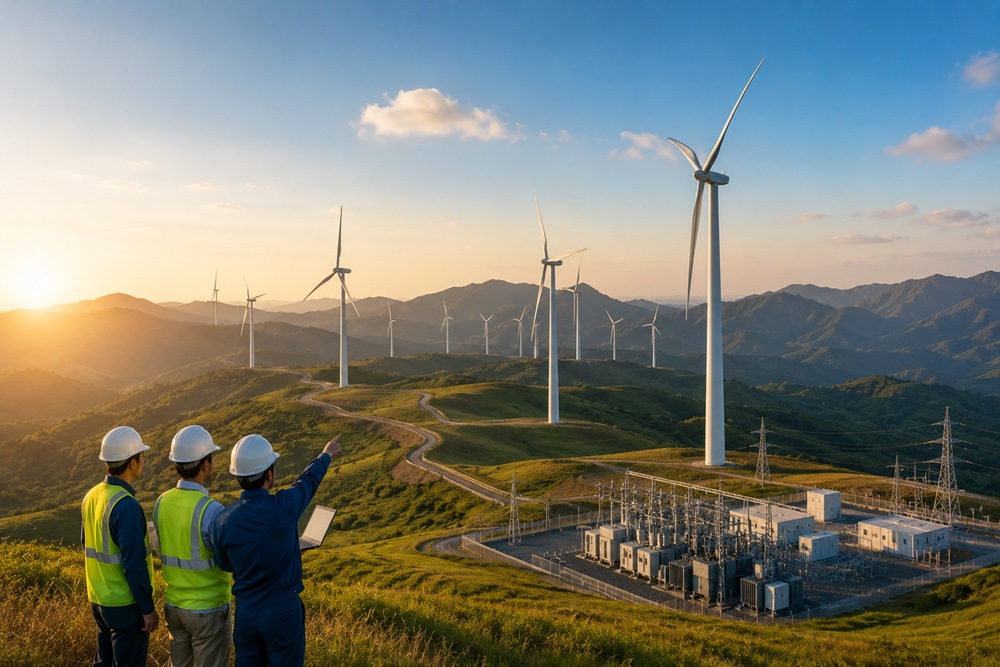
We designed, procured, and constructed the wind farm on a 5,000‑hectare steppe site, approximately 180 km from the capital city. The installation features 50 modern wind turbine generators (WTGs), each rated at 4.0 MW, connected through a medium‑voltage collector system to a newly built 220 kV substation. The plant now supplies clean electricity to the national grid, displacing an estimated 400,000 tons of CO₂ annually.
Why This Location? Strong, Consistent Wind Resources
The selected site lies in a recognized wind corridor with average annual wind speeds of 7.8 m/s at 100 m hub height. Prevailing winds blow from the north‑west for over 280 days per year, providing a capacity factor above 32%. This combination of high wind availability, flat terrain for easy construction, and proximity to existing transmission infrastructure made the location ideal for a national energy project cooperation initiative.
Local winters bring temperatures down to -25°C, with occasional snow and ice accumulation. Summers are mild, with average highs around 28°C. The site has no protected natural areas or archaeological constraints, which simplified the permitting process.
Technical Highlights
Modern Wind Turbine Generators
We selected 50 turbines from a leading Chinese manufacturer, each with:
- Rated capacity: 4.0 MW
- Rotor diameter: 146 m
- Hub height: 110 m (tubular steel tower)
- Cut‑in wind speed: 3 m/s
- Rated wind speed: 10.5 m/s
- Cut‑out wind speed: 25 m/s
The turbines feature three composite blades, each 71 m long. The blades use an aerodynamic profile optimised for low to medium wind speeds, with a special leading‑edge protection coating to resist erosion from airborne dust and ice particles. Each nacelle contains a permanent magnet synchronous generator (PMSG), gearless drive train, and full‑power converter. The gearless design reduces maintenance requirements and improves efficiency in cold climates.
SCADA and Remote Monitoring
A central SCADA (Supervisory Control and Data Acquisition) system collects real‑time data from every turbine. Operators can monitor power output, wind speed, nacelle position, blade pitch angle, and component temperatures from a single control room. The system also includes a condition monitoring module that detects early signs of bearing wear or gearbox anomalies, allowing predictive maintenance before failures occur.
The SCADA platform integrates with our remote operations centre. During the first year, our engineers diagnosed two emerging issues remotely and dispatched local technicians with the correct replacement parts, keeping turbine availability above 98%.
Cold Climate Adaptations
Winter operations required several design modifications:
- Blade anti‑icing system: Each blade has internal heating elements that activate when sensors detect ice accumulation. The system prevents ice buildup that could unbalance the rotor or throw dangerous ice fragments.
- Cold‑weather lubricants: All gearboxes, pitch drives, and yaw drives use synthetic lubricants rated to -40°C.
- Nacelle heaters: Internal heaters maintain component temperatures above freezing when turbines are stopped during extended maintenance.
- Turbine de‑rated operation: The control software reduces maximum power output when ambient temperatures fall below -20°C, protecting electronic components from cold stress.
Transformer and Substation
We built a new 220 kV/35 kV substation adjacent to the wind farm. The collector system connects turbines in 10 strings, each serving five turbines. Medium‑voltage cables (33 kV) run underground between turbines and from the strings to the substation. This underground design avoids overhead lines that could be damaged by ice or high winds.
The substation includes two 120 MVA main transformers, 220 kV switchgear, reactive power compensation equipment (STATCOM), and a control building. The STATCOM maintains the grid voltage within acceptable limits under varying wind output.
Project Challenges and Our Solutions
Challenge 1: Extreme Winter Weather
Construction work is impossible when temperatures drop below -15°C. We scheduled foundation concrete pours during summer and autumn, completing 80% of the 50 turbine foundations before the first winter freeze. For the remaining 10 foundations, we used insulated formwork and heated the concrete mix to allow curing at sub‑zero temperatures.
Turbine erection paused during the coldest months. We resumed in early spring with three erection crews working overlapping shifts. Despite the forced winter break, we completed all 50 turbine installations within the original 18‑month schedule.
Challenge 2: Remote Site Logistics
The wind farm is located 180 km from the nearest major city. Transporting 50 tower sections, 150 blades, and 50 nacelles required careful planning. We built a temporary laydown yard near the site and stockpiled materials before the winter season. A dedicated logistics coordinator managed deliveries from the port of entry (1,200 km away) using a fleet of specialised heavy‑haul trucks.
The longest blade measured 71 m. Transporting these required road permits and police escorts for each delivery. We worked with local authorities months in advance to secure the necessary approvals and to schedule deliveries during low‑traffic night hours.
Challenge 3: Skilled Labour Shortage
The region has limited experience with modern wind turbine construction. We brought a core team of 25 Chinese engineers and supervisors, then recruited 180 local workers. We ran a 6‑week training programme covering turbine assembly, electrical installation, safety procedures, and quality control. By the end of construction, 120 local workers had passed certification exams. Several are now employed by the client for long‑term O&M.
Challenge 4: Grid Integration Studies
The existing transmission network had limited reserve capacity. We conducted a full grid impact study during the design phase, modelling the wind farm’s effect on voltage stability, frequency response, and short‑circuit levels. The study identified the need for STATCOM equipment, which we included in the substation design. The grid operator approved the connection after reviewing our model results – a process that took six months but avoided costly retrofits later.
Project Results After One Year of Operation
We collected data from November 2025 to October 2026.
| Metric | Result |
|---|---|
| Total electricity generated | 560,000 MWh |
| Average capacity factor | 32.3% (guaranteed: 30%) |
| Turbine availability | 97.8% (industry benchmark: 96‑97%) |
| Grid compliance | 100% (no voltage or frequency violations) |
| CO₂ emissions avoided | 400,000 tons |
| Local jobs created (peak construction) | 205 |
| Permanent O&M jobs | 15 |
| Levelised cost of energy (LCOE) | $0.035/kWh |
| Simple payback for client | 8.4 years |
The client sells power to the national grid under a 25‑year PPA with a fixed tariff. By the second year of operation, the wind farm had already surpassed its annual generation target by 6%, primarily due to higher‑than‑expected wind speeds during spring months.
Environmental and Social Benefits
Beyond carbon reduction, the project delivers measurable local benefits:
- Air quality improvement: Displaced natural gas generation reduced local NOx and SO₂ emissions by an estimated 1,200 tons per year.
- Water conservation: Wind generation consumes no water, saving approximately 2 million cubic metres annually compared to a combined‑cycle gas plant of equivalent capacity.
- Land use: The 5,000‑hectare site remains largely accessible for grazing. Turbine foundations occupy less than 2% of the total area.
- Community investment: Our contract included a 0.5% community benefit fund, which financed a school renovation, a rural road upgrade, and a small medical clinic.
What the Client Says
“This was our first utility‑scale wind project, and we chose the right partner. The EPC team demonstrated exceptional capability in managing logistics, training local workers, and delivering on time despite a harsh winter. The plant consistently exceeds our performance expectations. We are now preparing the feasibility study for a second 300 MW phase.”
— General Director, National Renewable Energy Agency
Why This Project Exemplifies National Energy Cooperation
The project was structured under a government‑to‑government energy cooperation framework. Key features include:
- Financing: 65% from a Chinese development bank (concessional loan, 15‑year term), 35% from the client’s own funds.
- Equipment sourcing: 90% of major components from Chinese manufacturers (turbines, transformers, cables, SCADA), ensuring supply chain reliability.
- Technology transfer: Our training programme created a locally certified wind technician workforce that will support future projects.
- Local content: Civil works, road construction, and auxiliary services were subcontracted to local companies, meeting the 25% local content requirement.
The project has become a showcase for wind energy in Central Asia. Delegations from two neighbouring countries have visited the site, and feasibility studies for similar projects are now under way.
Lessons for Future Wind Power Projects
1. Start grid studies before site selection
We identified potential grid constraints during feasibility and chose a location with adequate transmission capacity. This saved at least six months of permitting delays.
2. Plan for winter construction from day one
Foundation work must be scheduled around freezing temperatures. Use insulated formwork and heated concrete where necessary. Stockpile materials before the winter season.
3. Invest in cold‑climate adaptations
Anti‑icing systems and cold‑weather lubricants cost more upfront but prevent costly turbine downtime during winter. We saw zero ice‑related shutdowns.
4. Build a local training programme early
Local labour is available but requires structured training. Start the programme before construction begins, so workers are ready when equipment arrives.
5. Include STATCOM or similar reactive power compensation
Grid operators increasingly require reactive power capability. Design it into the substation from the start – adding it later is far more expensive.
Common Questions About Wind Power Projects
Q: How much land does a 200 MW wind farm need?
Our project uses approximately 5,000 hectares. Turbines are spaced 5‑7 rotor diameters apart in the prevailing wind direction and 3‑5 diameters perpendicular. The actual footprint of turbine pads, roads, and substation is less than 2% of the total area.
Q: What is the typical turbine lifespan?
Modern wind turbines are designed for 20‑25 years of operation. Key components – blades, gearbox, generator – may require replacement or major overhaul after 15‑20 years. Our client has budgeted for a major refurbishment at year 18.
Q: How noisy are wind turbines?
At 500 m distance, sound pressure levels are typically 40‑45 dB(A) – comparable to a quiet suburban street. The nearest residence is 1.2 km from the nearest turbine, well above regulatory minimum distances.
Q: Do you offer EPC services for smaller wind projects?
Yes. We have delivered projects from 10 MW (community‑scale) to 200 MW (utility‑scale). Contact us to discuss your specific site conditions and capacity requirements.
Q: How long does a 200 MW wind farm take to build?
From notice to proceed, we completed this project in 18 months, including 3 months for detailed engineering, 6 months for civil works and foundations, 6 months for turbine erection, and 3 months for electrical integration and commissioning.
Q: What is the typical capacity factor for onshore wind?
Our project achieved 32.3% in the first year. Industry benchmarks range from 25‑40% depending on wind resource quality. Sites with average wind speeds below 6 m/s at hub height are generally not commercially viable without subsidies.
Ready to Discuss Your Wind Power Project?
Whether you need a community‑scale wind farm or a utility‑scale plant, our EPC team has the experience. We have delivered projects across Central Asia, the Middle East, and Southeast Asia. We handle feasibility studies, permitting, financing support, construction, and long‑term O&M.
Contact us for a preliminary site assessment and energy yield estimate.
Explore our other energy solutions: Solar PV Power Stations | Solar Thermal Power & Heating | Hydrogen Generation